What result should I expect, in millimetres or in plain language? "Natural, refreshed" is marketing. "A modest lift of the mid-face and some sharpening of the jawline, visible but subtle" is an answer.
What will this not fix? Every procedure has a list. If the list is empty, the consultation is a sales meeting.
Questions about the practitioner
What is your licence, and who supervises you? In California, threads are placed by physicians or by certain licensed practitioners under physician supervision. You want the licence type, the supervising physician's name, and how often that physician is physically present.
All three should come easily. If they do not, that is your answer.
How many thread lifts have you done, and how many in the last year? Numbers, not adjectives. Recent volume matters more than career totals.
Where did you train in threads specifically? Core clinical training is one thing. Thread technique is usually learned through manufacturer courses and private training, which vary.
The name of the course and the year are enough.
Who handles complications, and where? This is the question that gets dodged most. You want a named person, a phone number that works after hours, and a clear description of what happens if a thread extrudes or an infection develops on a Sunday.
Questions about the procedure
Which thread product, exactly? Brand and type, in writing. Threads are regulated medical devices and the specific product can be checked against public listings.
A practitioner who says "PDO" and nothing else has not told you the product.
How many threads, in which areas, in what pattern? The count drives both the result and the price. It belongs on the quote.
What anaesthetic, and what does the hour feel like? Local injections, then pressure and pulling, is the common description. If you are told it is entirely comfortable for everyone, note that.
What is the plan if the result is uneven? Threads can be adjusted or, in some cases, removed early. Ask what the clinic's approach is and whether any adjustment within the first weeks is included.
Questions about recovery
What exactly should I expect for the first three days, the first two weeks and the first month? You want a day-by-day answer, not "minimal downtime". Swelling peaks around day two or three.
Bruising fades over a week or more. Pulling and tenderness last a couple of weeks. Restrictions on chewing, sleeping position, exercise, facials and dental work run for weeks.
A practitioner who volunteers all of that is being straight with you.
When is my follow-up, and is it included? Two weeks is typical. It should be included.
What are the warning signs that mean I should call you? Increasing pain, spreading redness, discharge, fever, a thread visible at the surface, or a dimple that does not soften. Ask for these in writing.
Questions about money
What is the itemised cost? Threads, anaesthetic, follow-up, any adjustment. A single number with no breakdown is a red flag in a procedure where the count of threads varies fourfold between patients.
What is the deposit and refund policy if I change my mind? Ask before paying anything. Read the answer on paper.
Is there a cheaper package, and what is different about it? Fewer threads, a less experienced practitioner, a different product. The difference is the information, not the discount.
If the consultation is by video
Many Los Angeles clinics now offer a first consultation over video. It is convenient and it is limited. Nobody can assess laxity through a webcam.
Treat a video call as a screening conversation: use it for the practitioner and money questions, and insist on an in-person examination before any treatment plan or quote is final.
A clinic willing to quote a thread count from a video call has not examined you.
Lighting matters on video too. Sit facing a window. Do not use a filter.
A practitioner who cannot see your jawline clearly will either guess or ask you to come in, and the second is the better sign.
Two consultations, compared
A reader sent us notes from two consultations for the same concern, a softening jawline, in the same week. We have stripped the names.
The first lasted twenty minutes. The practitioner looked at her across a desk, said she was "a perfect candidate", recommended eight threads, showed a portfolio of dramatic before-and-after images taken in different lighting, and offered a discount if she booked that afternoon.
Questions about the supervising physician were answered with "he's great, he oversees everything". Questions about complications were answered with "we've never had one".
The second lasted forty-five minutes. The practitioner examined her face with gloved hands, pinched the skin at the jaw, and asked about weight history and sun exposure.
She was told threads would give a modest improvement that would need repeating, and that a more lasting change meant also seeing a surgeon. Six threads were suggested, with the product named. The supervising physician's name and schedule were given without being asked.
The complication protocol was on a printed sheet.
She chose the second. The point is not that the first clinic was dangerous. It may have been perfectly competent.
The point is that only one of the two consultations gave her the information to decide, and the questions on this list are how she noticed.
Reading the room
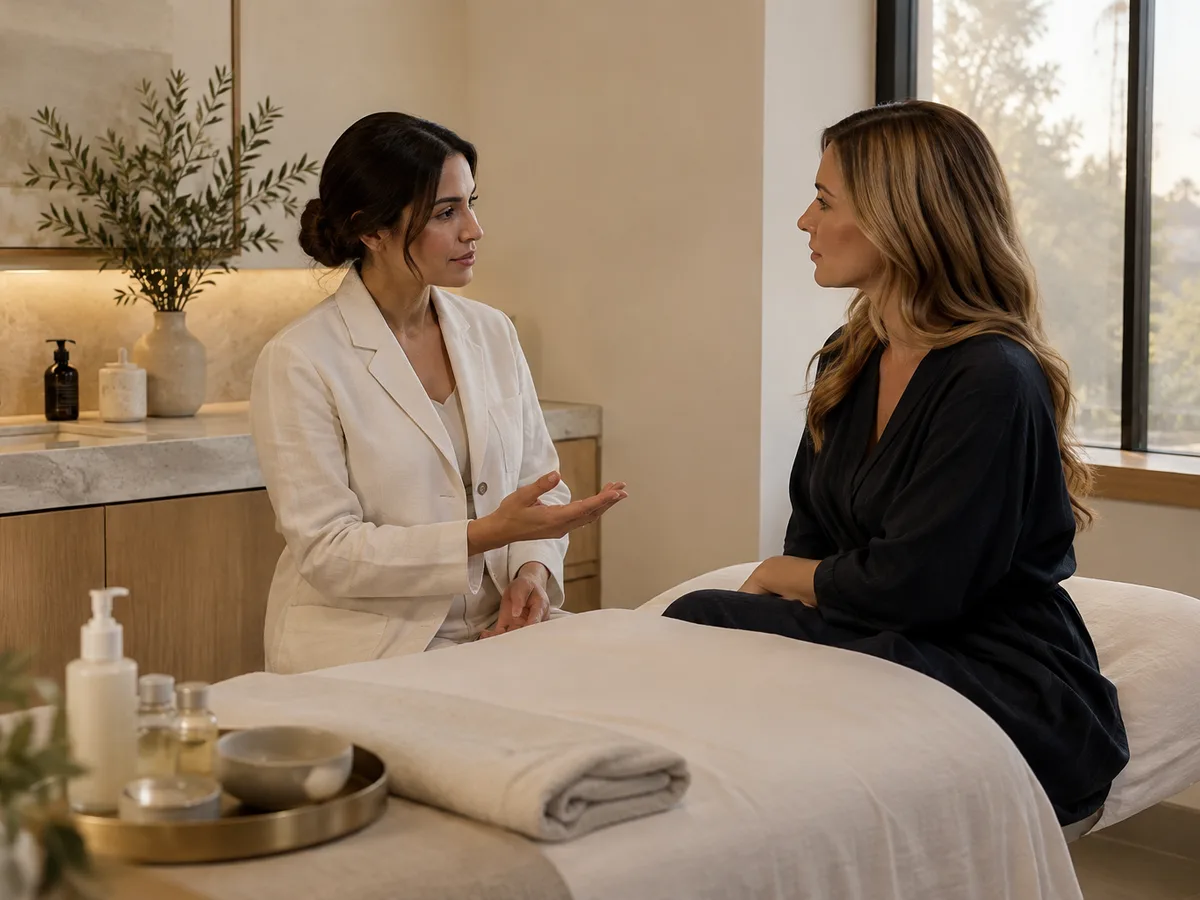
Beyond the answers, watch the consultation itself. Did anyone examine your face with their hands, or only look at it from across a desk? Was the person you met the person who will treat you?
Were before-and-after photographs shown under consistent lighting and angles, or under flattering ones? Did anyone use the word "guarantee"? Did anyone try to book you the same day with a discount that expires at five?
From the reader side, the working test is whether you left knowing more about your own face than when you arrived. If you left knowing more about the clinic's awards, go elsewhere.
Where the questions come from
Many of these were shaped by readers who wrote in after consultations that went badly.
Others came from patient-education material at local nursing and allied health programmes such as Valley College, and from the district-wide resources of the Los Angeles Community College District, which explain licence types and scope of practice better than any clinic website.
The neighbourhood council for the mid-city area, the Mid City Neighborhood Council, has also hosted community health sessions that surfaced good questions from people who had never been inside an aesthetic clinic. Good questions are not a specialist skill.
They are mostly the ones a careful relative would ask.
The next step
Take the list to more than one consultation if you can. The differences between the answers will teach you more than any single appointment.
When you are ready to compare a specific provider against it, one concrete move is to book a consultation for a PDO thread lift in Los Angeles and bring the printed list.
Then judge the practice by how many of these questions it answers before you ask them.
That is the whole method. Ask, write down the answers, and decide at home rather than in the chair.