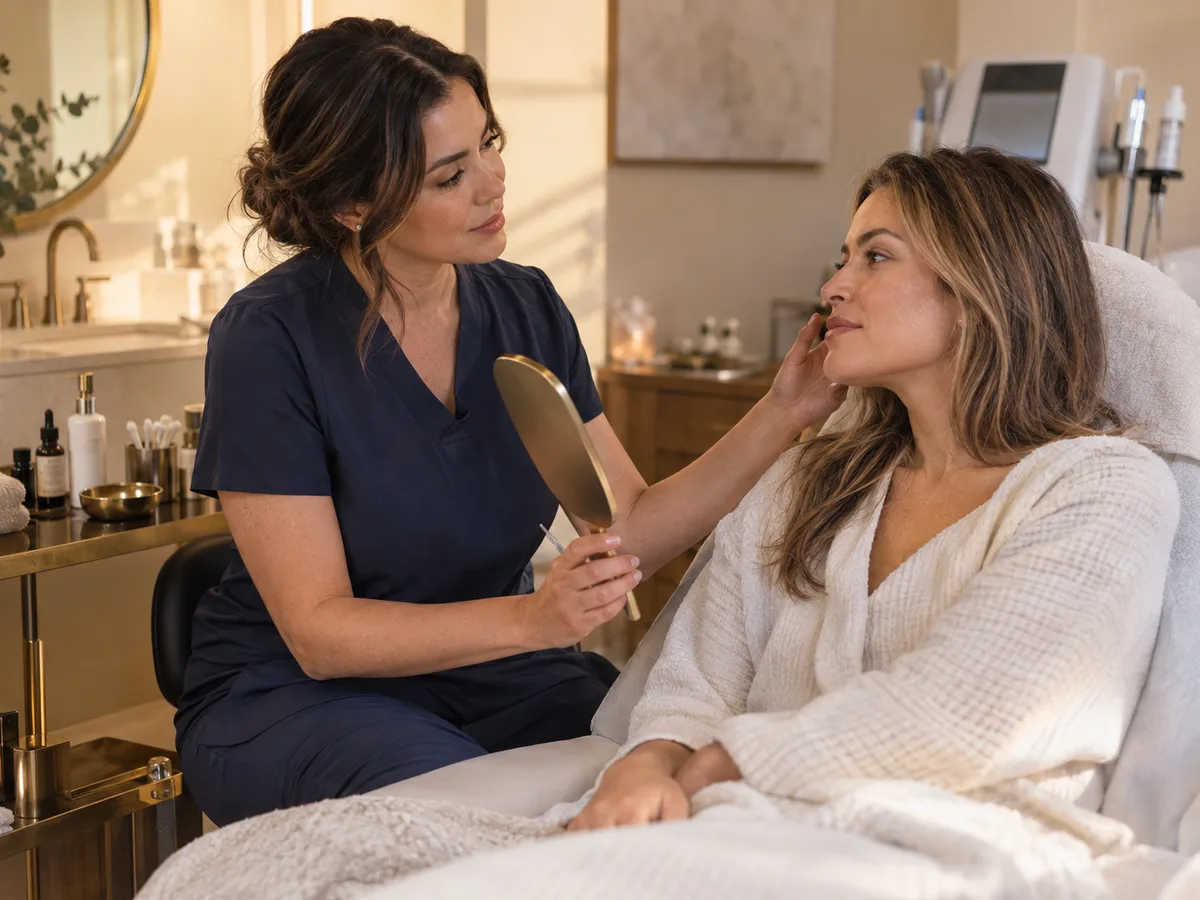
If the person who will treat you is a nurse or a PA, the two questions are who the supervising physician is and what that supervision looks like in practice. Both should be answered by name and in detail.
What supervision is supposed to mean
Supervision in California aesthetic practice has been the subject of enforcement actions precisely because it is so often nominal.
The state's expectation is that the physician is genuinely involved: that a good-faith examination has been performed by an appropriate licensee before treatment, that protocols exist and are followed, and that the physician is available.
A physician who has never seen the clinic and cannot be reached is not supervising in any meaningful sense, whatever the website says.
Questions that surface the reality: How often is the medical director physically here? Will a physician examine me before treatment, and who? If something goes wrong on a Saturday, who do I call and who will see me?
A well-run practice answers all three without hesitation.
The ten-minute verification routine
Step one: get the full name and licence type of the person who will treat you, and the full name of the supervising physician if they are not one. Ask directly. Refusal is your answer.
Step two: look each name up on the relevant California board's public licence search. Physicians and PAs are under the Medical Board of California and the Physician Assistant Board. Nurses are under the Board of Registered Nursing.
All sit within the state's Department of Consumer Affairs, which hosts the look-up tools.
Step three: check three things on each record. That the licence is current and not expired, suspended or on probation. That there are no disciplinary actions or, if there are, what they were for.
That the licence type matches what you were told.
Step four: search the physician's name together with the clinic's name. You are looking for whether they are publicly associated with the practice at all, and for any news of enforcement action.
Step five: check the facility. If the clinic uses any sedation beyond local anaesthetic, or performs anything more invasive, it may fall under facility licensing or accreditation requirements. The California Department of Public Health handles facility licensing for some categories.
Ask the clinic what its facility status is.
None of this takes long. All of it is more informative than the awards wall.
Credential claims to read carefully
"Board certified." In which specialty, by which board? Certification by a recognised specialty board is meaningful. Certification by an organisation that mostly issues certificates to people who attend its courses is not.
"Cosmetic surgeon." This is not a recognised specialty in the same sense as plastic surgery or dermatology. It describes what a physician does, not what they trained in.
"Master injector," "advanced practitioner," "thread specialist." Marketing terms with no regulatory meaning.
"Trained by" a named brand or manufacturer. Useful as information about technique exposure. Not a licence and not a credential.
"Medical director on site." Ask what on site means. Daily? Weekly?
For your appointment?
Complaints and what they tell you
Public disciplinary records are one of the few honest signals available. A single old citation for a paperwork issue is not disqualifying. A pattern of actions relating to supervision, patient harm or unlicensed practice is.
When you find the latter, do not rationalise it. There are other clinics.
What a licence does not tell you
Clearing the licence check is the floor. It tells you the person is legally allowed to do this and has not been caught doing it badly enough to be disciplined. It does not tell you whether they are good at it.
For that, the useful signals are volume, specificity and candour. Volume: how many thread lifts in the last year, as a number. A practitioner doing two a month and a practitioner doing two a day have different hands.
Specificity: can they name the product, explain their choice of material for your face, describe the vectors they plan, and give a thread count with reasons. Candour: do they tell you what threads will not do for you, and do they sometimes send people away.
Before-and-after photographs help if they are honest. Same lighting, same angle, same expression, no makeup, dated, and at least three months out rather than the day after.
Ask specifically for a case similar to yours that did not go perfectly and what was done about it. The answer tells you more than the portfolio.
Reviews are weak evidence. They measure how people felt about the consultation and the swelling, not the result at a year, and they are easy to curate. Read them for patterns in how complaints were handled rather than for star counts.
Out-of-town and travelling practitioners
Los Angeles attracts visiting injectors and "thread specialists" who run clinics for a few days at a rented space, often promoted through social media. Some are licensed in California. Some are licensed elsewhere and are not permitted to practise here.
Some are not licensed anywhere in a category that allows this procedure.
The verification routine applies with extra force. A practitioner who will be in another state next week cannot handle a complication on day five. Ask who will see you locally if something goes wrong, and verify that person too.
If the answer is a phone number in another time zone, the convenience of the pop-up is not worth it.
The same caution applies to procedures marketed for travel abroad. Threads placed overseas are threads that no local practitioner placed, knows the material of, or is obliged to manage. If you are considering it, budget for the complication as well as the price.
Sources and local context
The licence look-up tools referenced above are public and free.
Sun protection during recovery is a practical concern in this city, and the daily UV index published by the EPA is a simple way to decide whether an afternoon errand should wait.
Readers recovering indoors have recommended LACMA as a week of dim, cool afternoons; its galleries are a better environment for a bruised face than a Wilshire sidewalk.
If the practice is a chain
Multi-site practices complicate the check rather than simplifying it. The medical director named on the website may cover several locations, so ask which physician is responsible for the branch you will attend.
Run that name through the same board look-up. A chain that cannot tell you who supervises a specific address has answered the supervision question for you.
Putting it together
With that context, the better question is not "is this person qualified" but "can I verify, in public records, that this person and their supervising physician are licensed, current, undisciplined and genuinely connected to this clinic".
If the answer is yes, you have cleared the floor and can move on to judging skill, volume and honesty. If the answer is no, or the practice makes it hard to find out, the question of skill never arises.
The routine works on any clinic. Take a practice that lists thread lifts among its services, such as My Aesthetic Doctor, and run the named practitioners through the board look-up before paying a deposit, exactly as you would with any other.
The point is not to trust or distrust a particular clinic. It is to make the check a habit that no website copy can substitute for.
Write down what you find. Take the notes into the consultation. A practice that welcomes that is the kind you want.