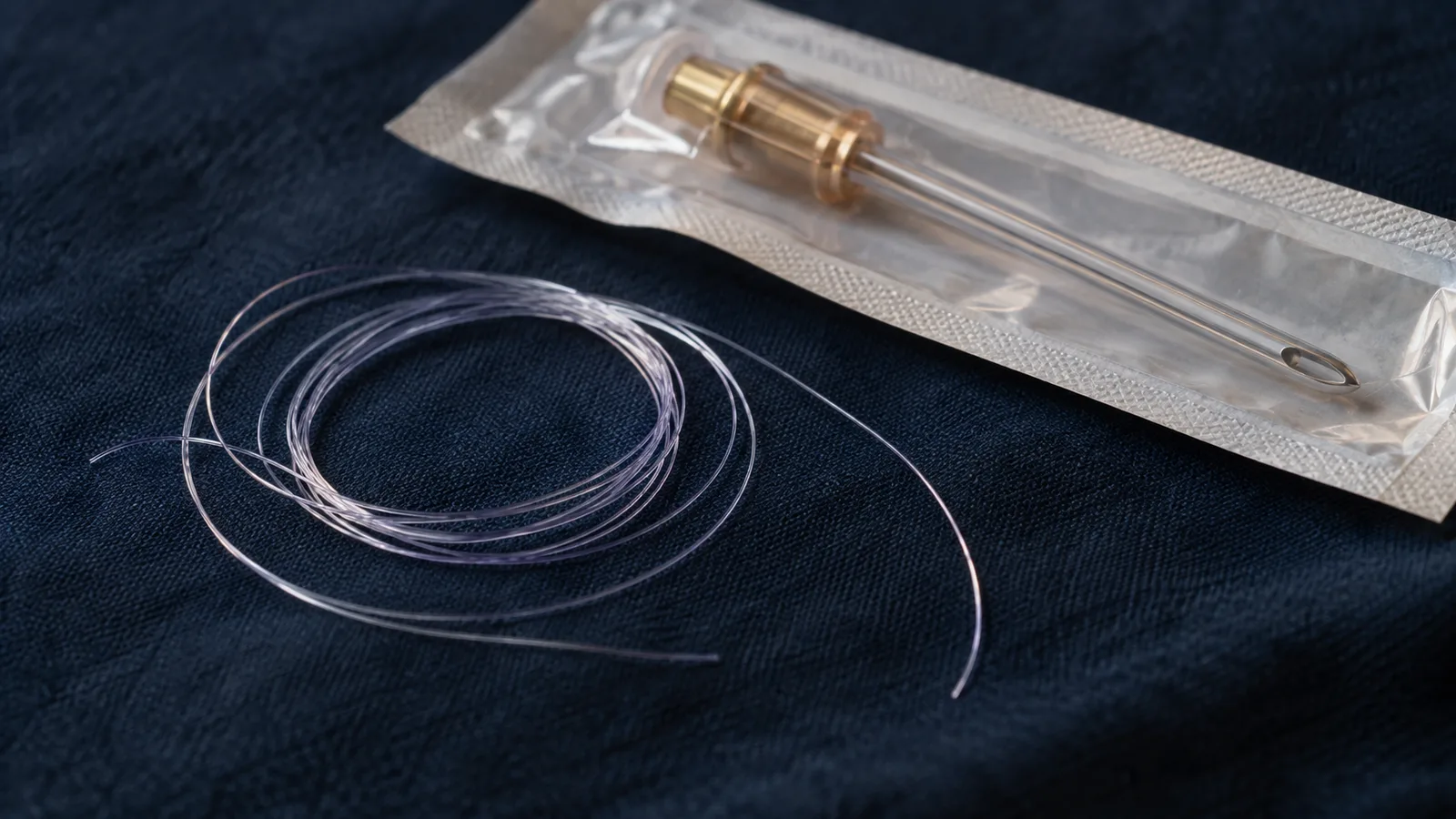
The practitioner is aiming for a plane that is deep enough to avoid dimpling the surface and shallow enough to engage the tissue that has sagged.
Once the thread is in position, gentle traction is applied. The barbs engage the tissue, and the practitioner slides the skin upward along the thread so that the sagging tissue is gathered and repositioned. The free end is trimmed flush.
Several threads are placed in a fan pattern across the area. The whole thing takes somewhere between thirty minutes and an hour and a half, depending on how many threads and how many areas.
The entry points are tiny. The internal path is not. Understanding that distinction explains most of the recovery experience: the surface heals in a day, the tissue that has been gathered along a barbed suture takes weeks to settle.
Where the lift comes from, in two phases
On the day, the lift is mechanical. Tissue has been physically gathered along the thread and held by the barbs. This is the result you see in the mirror when the swelling starts to go down.
It is also the part that has the shortest life, because PDO begins to lose tensile strength within weeks and is largely absorbed by around six months, give or take, depending on thread thickness and the individual.
The second phase is the one the industry leans on. As the body breaks down the thread, it forms fibrous tissue along the path. This is a foreign body response and it does involve new collagen.
Whether that new collagen produces a visible, durable improvement in firmness is where the evidence gets thinner and the marketing gets louder. Some people notice a firmer texture along treated lines for months after the threads are gone. Some do not.
The honest position is that the collagen phase is real at the tissue level and variable at the mirror level.
When a clinic quotes a lifespan that runs well past the absorption time of the thread, it is quoting the collagen phase. Ask them to say so.
What "lift" means in practice
The amount of movement is measured in millimetres. A well-placed set of threads in someone with mild to moderate laxity can soften a jowl, sharpen the jawline a little, and lift the mid-face enough to reduce the fold beside the nose.
That is a meaningful change for the right candidate.
It is not a facelift. A surgical facelift repositions the deeper layer of muscle and fascia and removes excess skin. Threads gather tissue in the layer above that and remove nothing.
If the concern is heavy, redundant skin, threads have nothing to do with it. From the reader side, the working test is simple: pinch the loose skin at your jaw. If you are holding a fold, you are probably past what threads address.
Why the effect fades, and why the number of threads matters
Two things limit the lifespan. The thread loses strength and dissolves, and the barbs, which are small, gradually cut through or slip within soft tissue under the constant load of gravity and facial movement. More threads share the load.
Thicker threads hold longer. Careful placement in the right plane resists slippage better than placement that is too shallow. None of this can be fully controlled, which is why longevity figures should always be read as ranges.
The number of threads also bears on the quote. A "thread lift" of four threads and a "thread lift" of sixteen threads are different procedures with different results and different prices. Ask for the count in writing.
What the mechanism implies about risk
If you understand that a barbed filament is sitting in the subcutaneous layer under tension, the risk list writes itself. A thread placed too shallow can show as a ridge or cause a dimple where a barb tethers the skin. Uneven traction shows as asymmetry.
A thread end left too long can poke through the skin, which is called extrusion. Any procedure that breaks the skin can introduce infection. Nerve irritation and prolonged pain happen in a minority of cases.
All of these are recognised, all are usually manageable, and none of them should be news to you after a proper consultation.
Sources and further reading
The device side of this is regulated. Thread products are medical devices and have listings that can be checked rather than taken on trust.
For how this sits in the local economy, the regional reports from the LAEDC, the county's economic development body, give a sense of how large the aesthetic services sector has become in the county.
That scale explains why so many clinics offer threads and why so few of them explain the mechanics in detail.
For a layperson's refresher on how skin and connective tissue are built, the human biology exhibits at the California Science Center in Exposition Park are a surprisingly good hour, and free.
Those wanting the vocational angle, meaning how the people placing threads are trained in the first place, can look at the allied health programme listings at Trade-Tech, the Los Angeles Trade-Technical College, which spell out the differences between licence types in a way clinic websites rarely do.
Common misreadings of the mechanism
Three misunderstandings come up in reader mail often enough to deserve their own section.
The first is that the threads "tighten the skin". They do not, at least not directly. The barbs engage subcutaneous tissue and pull it upward; the skin follows because it is attached to that tissue.
Skin that is loose in its own right, thinned and stretched, is not tightened by a thread beneath it. It is draped slightly differently.
This is why people with good skin quality and mild descent do well, and people with crepey, lax skin are often disappointed.
The second is that "more collagen" means "more lift". The collagen formed along a thread path is scar-like tissue in a line. It can firm the line it follows.
It does not gather tissue the way a barb does, and it does not continue lifting after the thread has gone.
Where a practitioner describes the collagen phase as though it were a slow-motion facelift, they are describing something the tissue does not do.
The third is that a thread lift is reversible in the way a hyaluronic acid filler is reversible. It is not. A filler can be dissolved with an enzyme in a day.
A thread can sometimes be pulled out in the first days if a problem is obvious, but once the tissue has begun to grip it, removal is a small procedure with its own risks. Otherwise you wait for it to absorb.
Someone nervous about a visible mistake should weigh that difference seriously before choosing threads over a dissolvable alternative.
A fourth, smaller point. The "lunchtime" framing describes the appointment length, not the recovery. The hour in the chair is short.
The two weeks of not chewing steak are not.
Margin note
A PDO thread lift works by gathering sagging soft tissue along barbed, dissolvable sutures and holding it there while the body forms fibrous tissue along the thread. The mechanical lift is immediate and modest. It fades as the thread weakens and dissolves over months.
Any lasting firmness comes from the tissue response, which varies from person to person and should be described that way.
If a practitioner can explain all of that to you without a brochure, you are in reasonable hands. If they cannot, or will not, that tells you something too.