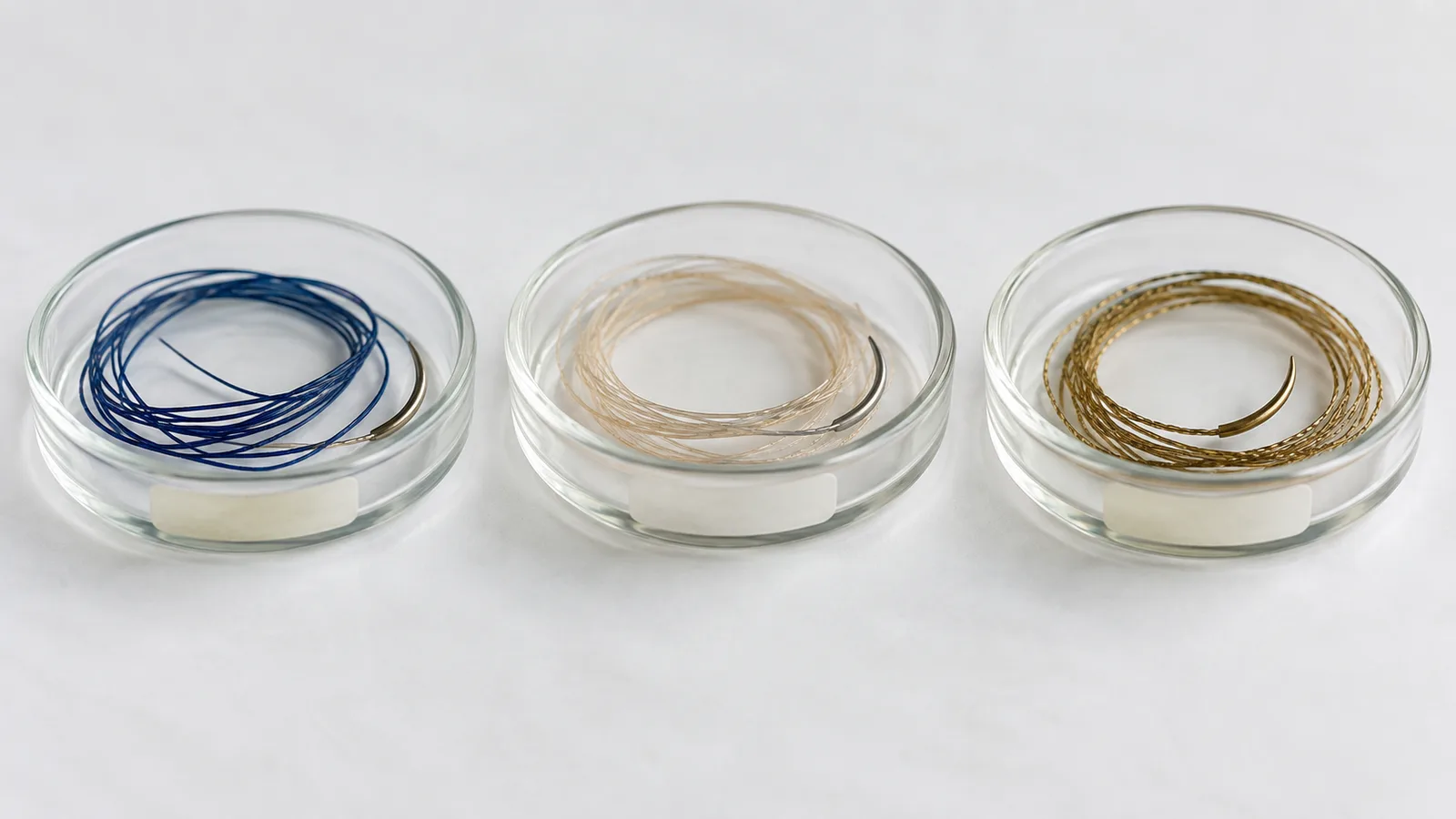
A practitioner quoting a long result for PCL is closer to describing the material itself. Neither is wrong, but you should know which you are being told.
What the collagen response changes
All three materials provoke a foreign body response as they degrade, and that response includes new collagen along the thread path.
The strength and duration of the response vary by material, with PLLA and PCL generally described as producing more of it, over longer, than PDO.
Whether that translates into a visible, durable difference in firmness varies by person and is where marketing tends to outrun evidence.
When comparing options, the choice often turns on whether you value a stronger immediate lift or a longer, gentler firming effect. PDO cog threads with generous barbs give the former. Slower-absorbing materials lean toward the latter.
Some practitioners combine them for that reason.
What stiffness changes
Under thin skin, at the temple, along the neck or near the eye, a stiffer thread is more likely to be felt as a ridge or seen as a line. PDO is moderately stiff. PCL is softer.
This matters less in the mid-face, where the tissue is thicker, and more in the areas where threads are most often regretted.
A practitioner who chooses material by area, rather than using one product for everything, is showing the kind of judgement you want.
What the material changes about risk
Longer-lasting materials stay in the tissue longer, which means any problem with a thread, such as a visible ridge, a persistent dimple or a low-grade reaction, also lasts longer or has to be dealt with by removal rather than by waiting.
Shorter-lasting materials are more forgiving in that sense: if a PDO thread is unsatisfactory, it will be gone within months. That is a real consideration for a first procedure.
Reactions to the materials themselves are uncommon. All three have long histories in medicine. Ask anyway, and mention any history of reactions to sutures or implants.
What the material changes about cost
Slower-absorbing threads generally cost more per thread. Whether that is better value depends on how the result holds and how often you would otherwise repeat the procedure.
A useful exercise is to divide the quoted price by the practitioner's honest estimate of duration, for each material, and compare the per-year figure. It is rough, but it exposes quotes that look cheap and are not.
Thickness and barb design
Material is one axis. Thickness and barb design are two more, and they interact with it.
Thread thickness is given in suture gauge or in millimetres, and thicker threads hold more and last longer within the same material.
A fine PDO mono thread and a heavy PDO cog thread are the same polymer doing very different jobs: the first firms a small area with almost no lift, the second carries real tissue.
Practitioners choose gauge by area, with heavier threads in the mid-face and jawline and finer ones where the skin is thin.
Barb design varies more than most people realise. Barbs can be cut into the thread, which weakens it slightly, or moulded onto it, which does not.
They can point in one direction, for a straightforward lift toward an anchor, or in two directions from a central point, so the thread holds tissue from both ends without a fixed anchor. Some designs use cones threaded onto a smooth suture rather than barbs.
Each behaves differently under load and each has practitioners who swear by it.
You do not need to become an expert in barb geometry. You do need a practitioner who can tell you which design they are using and why it suits the area and the direction of lift. "Cog threads" is a category.
It is not an answer. If the reply is a brand name and a shrug, ask what the barbs look like and which way they point; a practitioner who places threads every week can draw it on a napkin in ten seconds.
Mixing materials in one face
Practitioners increasingly combine materials within a single treatment plan.
A common pattern is heavier lifting threads in the mid-face and jawline, in whichever material the practitioner prefers for hold, with finer smooth threads in a mesh nearby to add texture and support, sometimes in a different material chosen for its tissue response.
Another is a slower-absorbing material for the lift and PDO for the finer work, so that the mesh is gone before the lift begins to fade.
The logic is sound. The paperwork should keep up. If several products are used, each should be named on the consent and the quote, with counts.
If a problem arises later, you and whoever treats it will want to know exactly what is where and how long it will be there.
Regulatory status, without the shorthand
Threads are medical devices. Their regulatory status is specific to the product and to the intended use listed for it, and it is not something to accept as a slogan.
Ask for the exact product name and check its listing yourself on the regulator's public database. The point is to know what has been cleared for what, not to collect reassuring phrases.
A product that cannot be found under the name you were given is a reason to ask more questions before proceeding.
Questions to ask about material
Which product, by name? Which material or blend? How thick are the threads and how are the barbs arranged?
Why this material for this area of my face? What is your honest estimate of duration for this material in someone like me? What happens if I dislike the result and the material lasts two years?
A practitioner who can answer all six fluently has thought about materials. One who says "they are all much the same" has not, or would rather you did not.
The unrelated but useful
Readers ask us, half joking, where to spend a recovery fortnight that involves no sun and no chewing. The Petersen Automotive Museum on Wilshire is one answer several have given: hours of cool, dim galleries where nobody is examining your jawline.
And for those who have confused their agencies, as more than one reader has, the California Public Utilities Commission regulates utilities, not medical practitioners; licence complaints go to the relevant board under the Department of Consumer Affairs.
What readers are told, and what they are not
Readers who send us their paperwork show a consistent gap. The consent form names the procedure and the risks. The quote names the price.
Neither names the material, and in most cases the practitioner had to be asked directly. That gap is worth closing before you pay, because the material decides how long any problem lasts as well as how long the result does.
Margin note
PDO is soft, short-lived and forgiving. PLLA absorbs more slowly with a stronger tissue response. PCL lasts longest, is softest, and costs most.
The material decides the clock on your result, the feel under thin skin, the length of any problem and much of the price.
It belongs on your quote by product name, and a practitioner who cannot explain why they chose it for your face is a practitioner to question.